
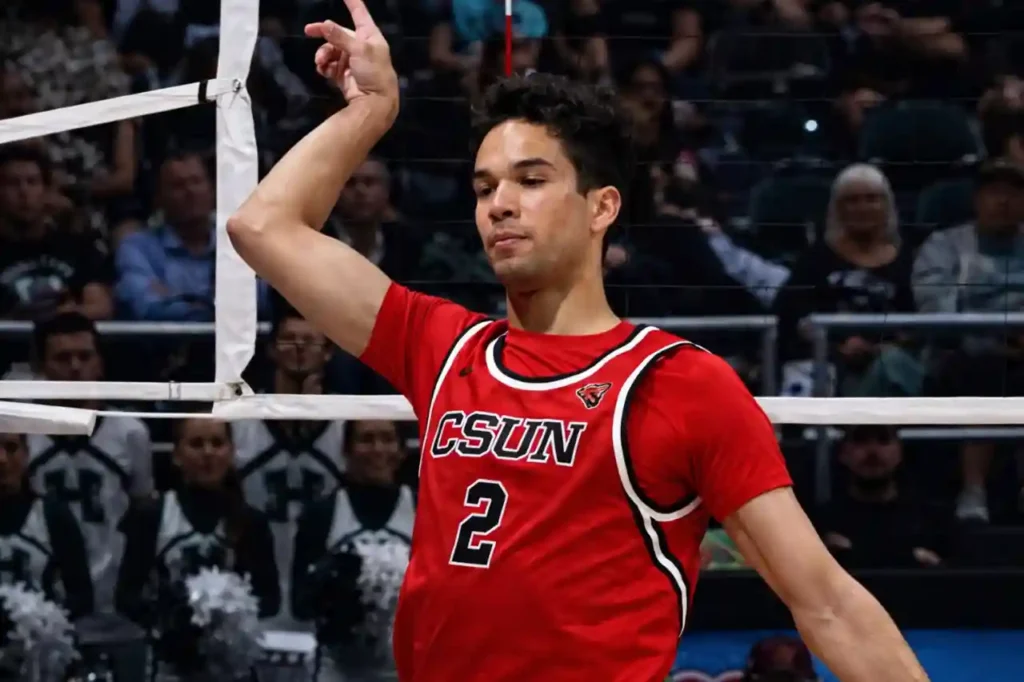
In the high-stakes arena of collegiate volleyball, personality and performance are often inextricably linked. For California State University, Northridge (CSUN) outside hitter Jordan Lucas, his flamboyant playing style marked by signature hair flips, expressive celebrations, and unshakable confidence has always been a core component of his game. However, a single, ill-conceived remark from a veteran broadcaster in April 2026 transformed Lucas from a standout college athlete into a national symbol of resilience and LGBTQ+ representation.
The Incident That Sparked a Movement
On April 9, 2026, during a match between CSUN and the University of California, Irvine (UCI), long-time announcer Charlie Brande broadcasted a comment that would quickly ignite a firestorm of controversy. As Lucas celebrated a point with his customary flair, Brande remarked on-air, “I’m amazed Jordan Lucas hasn’t been popped by somebody,” describing the athlete’s actions under the net as “very distasteful.”
The reaction was immediate and overwhelming. Social media platforms erupted as fans, fellow athletes, and civil rights advocates condemned the broadcaster’s language, which many interpreted as an implicit endorsement of physical violence against an openly gay player. Within days, the backlash became so severe that UC Irvine removed Brande from his position as a commentator, citing that his remarks failed to align with the institution’s values of professionalism, sportsmanship, and respect.
Brande later issued a public apology, taking full responsibility for his words and acknowledging that violence has no place in sports. Yet, for Lucas, the incident served as a catalyst for a much broader conversation regarding the treatment of LGBTQ+ athletes in collegiate athletics.
Authenticity as an Armor
Rather than retreating from the spotlight or tempering his on-court persona, Jordan Lucas leaned into his identity. In the weeks following the incident, Lucas maintained his signature style, continuing to celebrate with the same vigor that had previously drawn the announcer’s ire.
“People either really love the way that I play or people really hate it, but regardless, you’re still talking about me,” Lucas stated in an interview. This perspective highlights a level of emotional maturity that has defined his response to the controversy. By refusing to police his own joy or curtail his self-expression, he effectively stripped the insult of its power, turning a moment of hostility into a platform for empowerment.
CSUN head coach Theo Edwards, who has mentored Lucas since his early teenage years, praised his athlete’s response. Edwards described Lucas as one of the toughest players he has ever coached, noting that his resilience extends far beyond the court. In June 2025, Lucas suffered the tragic loss of his mother, Christina, to cancer a private burden he carried while continuing to compete at a high level. That internal fortitude, Edwards suggests, is why Lucas was able to weather the public storm with such grace.
A New Voice for Visibility
The narrative surrounding Jordan Lucas has shifted dramatically from one of victimization to one of advocacy. The controversy inadvertently provided Lucas with a megaphone, one he has chosen to use to champion the visibility of LGBTQ+ athletes.
Since the incident, Lucas has appeared in major media outlets, including The Athletic and Good Morning America, and has been invited to prominent entertainment events. However, he remains focused on the impact his journey has on younger athletes. He emphasizes the importance of representation, citing the older LGBTQ+ athletes who helped him believe he could succeed while remaining true to himself.
By remaining at the forefront of this discourse, Lucas is proving that talent and authenticity are not mutually exclusive. He serves as a bridge for the next generation, demonstrating that being “himself” is not a detriment, but a strength.
The Impact on Collegiate Sports Culture
The “Jordan Lucas effect” has forced institutions and broadcasters to re-evaluate their standards for sports commentary. The incident at UCI has become a case study in the consequences of unprofessionalism, prompting universities across the country to reinforce expectations of inclusivity.
Moreover, the event sparked a wider debate within the volleyball community. While some critics argued that the announcer’s comments were directed at the nature of “taunting” rather than the player’s sexuality, the overwhelming consensus within the national discourse has been that the language used suggesting an athlete should be “popped” is unacceptable regardless of the context. The incident has effectively pushed the conversation toward a higher standard of decorum, ensuring that players’ celebrations are not met with calls for violence.
Looking Ahead
As Jordan Lucas continues his journey as a collegiate athlete and an emerging public figure, his legacy is already firmly cemented. He did not ask for the controversy, but he has certainly defined the outcome. By turning a moment of prejudice into a national rallying point, he has demonstrated that even in the face of outdated attitudes, an athlete’s spirit remains unyielding.
For those who follow collegiate volleyball, Lucas is no longer just the player with the hair flips and the confident smile. He is a trailblazer who refused to be silenced, turning an attempted insult into a testament to the power of being authentically oneself. As he continues to compete, his fans now national in scale look forward to seeing how his voice and his game will continue to evolve in a landscape that he has helped reshape.